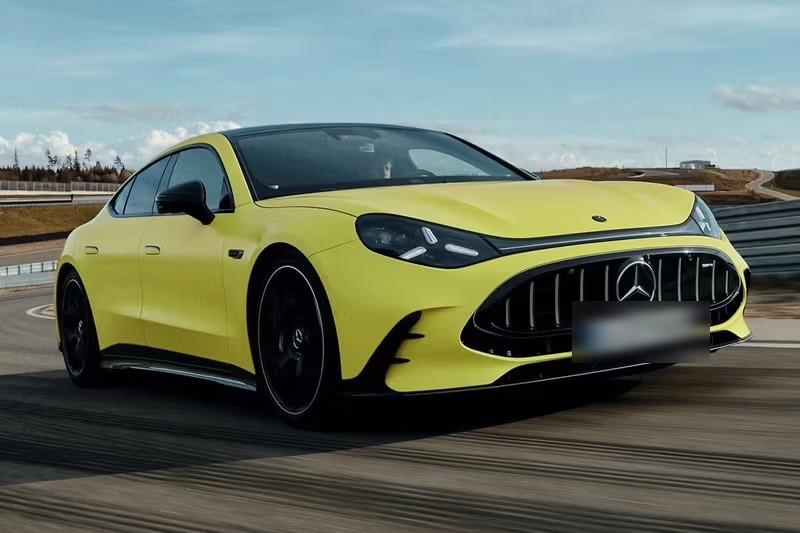
Regarding modern cars, the design language usually takes some getting used to in order for me to properly enjoy it. An example for this is the Ferrari Amalfi, which I was originally disappointed with, because to me it was just a Roma facelift, but after some time I’ve learned to really appreciate the design over the otherwise boring Roma. So seeing a new car I immediately like is an absolute rarity.
One of these cases is the new Mercedes-AMG GT 4-Door. Much like every modern car, the comment section under every related post absolutely hated on it immediately.
I’ve said before, we should take some time before we judge the design, in this instance there was no need for me to do that. That doesn’t mean I don’t have my gripes with the car, but I will get into those as well.
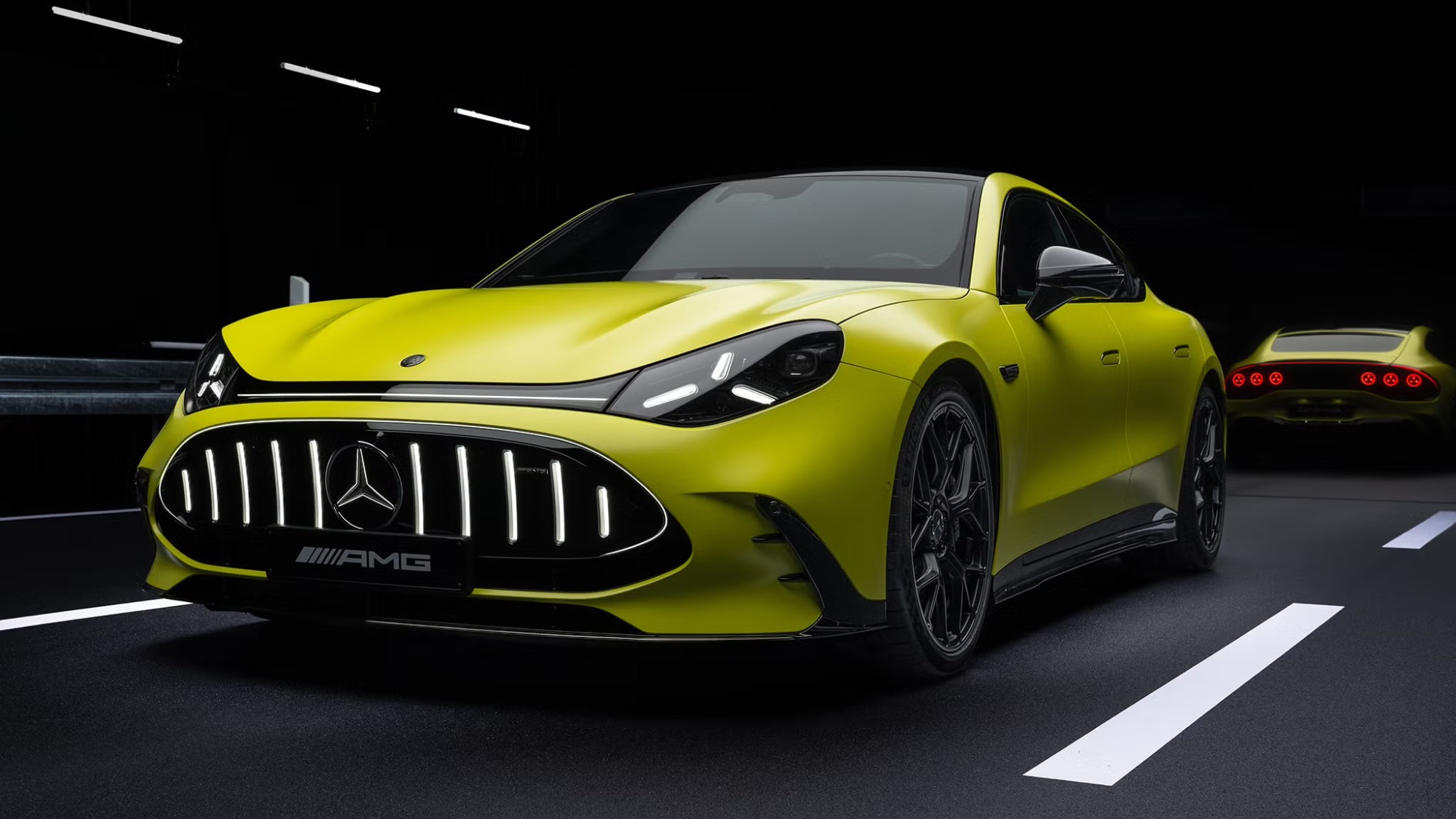
Upon laying your eyes on the car, it becomes apparent that the design language is extremely different from the previous generation of the 4-door AM GT 63. Most notably the headlights featuring the Mercedes star, incase you forgot what brand you’re driving, which are both connected by a black stripe, similarly to the current Ferrari lineup like the 12Cilindri, 849 TR and F80. People say it’d look better without the stripe, but I tend to disagree. The line adds some sort of coherency to the front that is simply missing when removed. A good example of this is the G80 M3, which everyone hated at first because the grille was ‘too big’. So when the tuning company Adro made an alternative bumper fixing that issue you would expect that every G80 M3 on the streets has one now? No, until this day i have not seen a single person actually install one outside of 2-3 social media posts. So I predict like with the G80, people will make covers for it, but no one will buy it, because it doesn’t actually look that bad.
I also like the Grille, it takes a lot of inspiration from the AMG GT XX concept that we saw last year.
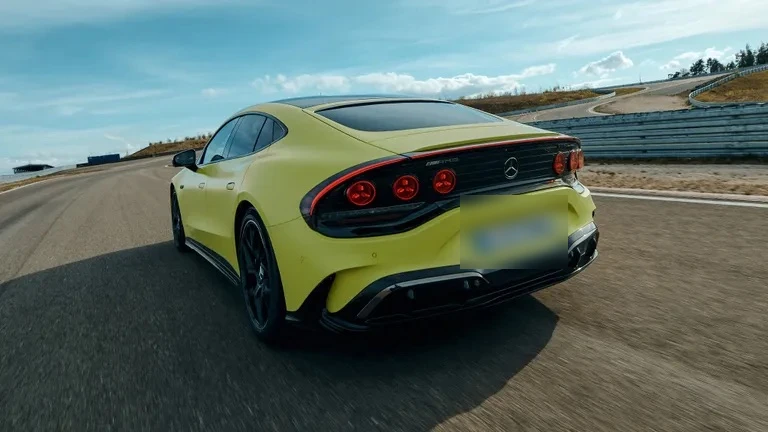
Moving onto the backside of the car, the creative design continues. What immediately caught my eye was the huge space taken up by the taillights.
We saw a similar, more restrained rear design on the GT XX, but the production variant takes that idea a bit further. To the point where I had to immediately think of the taillights on the new Aston Martin Vanquish which heavily resemble the ones on the GT 63. Another highlight of the car is the active rear diffuser. When I first saw it in action I was surprised by how far it extended. Active aero on a mass production car has always been very tame, if you’re lucky you get a retractable spoiler. This AMG doesn’t just have a retractable spoiler but a fully retractable and extendable rear diffusor to manipulate air flow under to car in order to boost the cars performance.
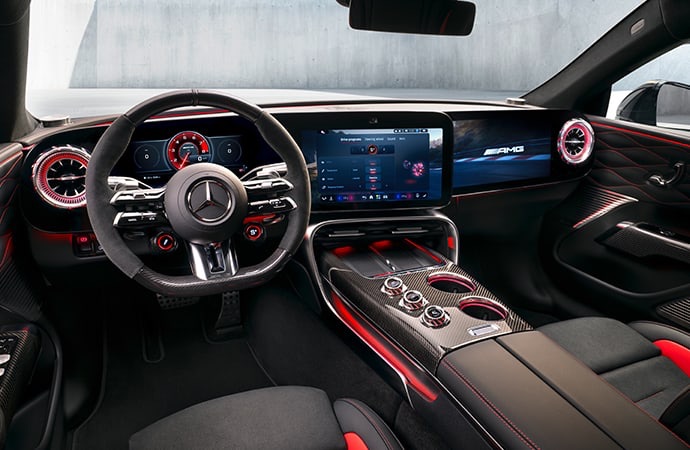
When taking a look inside, the interior isn’t too terrible. If you manage to ignore the dashboard made up of two massive screens then it’s actually quite decent. The dials, carbon fiber and silver accents all give you that sporty feel that an AMG should.
Mercedes really should redesign the interior. The 2027 Maybach S-Class features a similar dashboard and nothing screams high-end like fingerprints on your screens.
The new generation of the 4-door GT 63 is fully electric. This is the first series production car to use axial flux motors, co-developed with British specialist YASA that AMG acquired in 2021. Unlike conventional radial motors, axial flux designs run electromagnetic flux parallel to the rotation axis, enabling dramatically higher power density in a much slimmer package. Each rear motor sits in a housing just 8 cm wide.
In AMG S+ mode the car plays a V8 engine note built from over 1,600 sound files mapped to throttle input. We’ve seen similar technology already, notably in the 2009 Brabus Ultimate High Voltage based on the Smart ForTwo and the 2009 Brabus modified Tesla Roadster which let the driver choose from a selection of 3 sounds ranging from V8 and F1 sounds to a more fictitious spacious sound.
The difference is that in 2009, that technology had a novelty to it, which has now worn off. The only way I can explain it is by comparing it to vegan food. Vegans don’t want to eat steak because they thinks it’s immoral, but do everything in their power to try to replicate the taste and texture of it. Mercedes is taking the V8 away from you for the sake for the environment, but tries to simulate the experience of it.
The car has three axial flux motors producing 1,153 HP and 1,475 lb-ft of torque. It can sprint from 0-60 mph in 2 seconds flat. The full 1,153 HP can only be used for 63 seconds at a time before stepping back to a more sustainable 721 HP.
The range of the GT 63 will be 700 km. What’s very interesting is that Mercedes is bringing back the 55-AMG verkante again. Previously the AMG GT only came as 43-, 53- and 63-AMG variants, so seeing them bring the 55-AMG back is great. We already saw Mercedes do this with the SL R232 which was also available as a SL 55. This one will have 805 HP with a 0-60 mph in under 3 seconds with 700 km range as well.
AMG has confirmed that up to 1,300 HP is possible from the platform, hinting at a faster trim.
To me it’s ridiculous that the HP-gap between cars is getting wider and wider. What I mean is that entry performance cars are slowly dwindling. Yes, the technology is evolving but the drivers aren’t. Imagine driving an old 100 HP Golf your whole life, because any new car isn’t affordable enough from you. Then you finally get some money and decide you want your first ever sports car, you settle on an AMG. Now you’re sitting in a car with the same amount of power as older hypercars and modern supercars. Where is the in-between? I think the AMG-, RS- and M-Cars should be a stepping stone from a normal car to an actual Supercar.
Price wise the GT 63 is expected to be around 220,000 €, but as of now Mercedes has not confirmed one. To me the price is getting outrageous, not because it’s expensive in general, I see no issue for a car to cost 200,000 € or above. But it’s wild that Mercedes expects people to pay Supercar prices for a regular AMG. The AMG GT is an enthusiast car, at least that’s what it has always been. So when you present enthusiasts with such a huge price tag, many will be looking in the direction of an actual Supercar with high revving V8’s, V10’s and V12’s. But since the price hasn’t been confirmed yet bickering about it is more or less useless.
What is extremely disappointing to me is the EV aspect. I get why a daily car would be better as an EV, but not a performance car. Mercedes seems to not be learning from their past mistakes, like the C 63 S E-Performance which featured a 4-Cylinder. After horrendous sales for it, Mercedes announced they will not be getting rid of their V8’s fully. So I don’t see the point in not giving their flagship sports car anything but a biturbo V8.
I’ve had a conversation about this with a friend of mine. He hopes that AMG will release the AMG GT 63 Coupé with a combustion engine, in the context of other brands like Lotus and Porsche announcing that they plan on stepping back from a full EV lineup. The Platform and Motor for the GT 63 has presumably been in development ever since Mercedes first acquired YASA in 2021, so it was ‘too late’ for them to change the engine. We both agree that the car will not sell well, where we disagree is that he thinks the Coupé version will feature a newly developed combustion engine and I think Mercedes will need to bite the bullet and give us both models as an EV despite poor sales. With the AMG GT Black Series being in development, perhaps we could see a GT 63 Black Series version, featuring a combustion engine, but I highly doubt it. What’s most realistic is that Mercedes is trying to upsell consumers to buy their future most expensive production car, the AMG GT Black Series, by starving you of a combustion engine until you reach the top of the ladder in terms of AMG performance cars. A theoretical benefit of it being a EV is that you could get one for cheap on the used car market. EVs tend to not perform very well on the second hand market, especially in the long run. So there’s a chance that in a few years you’ll see these for sale in the 20,000 €-50,000 € range. A great example of this tremendous depreciation is the ID. lineup from Volkswagen. For example, a 2023 ID.7 can be found, used, for € 37,000 while starting at a price of 54,000 € new. Thats a 46% depreciation in 3 years, pure madness.
The thing I am waiting for more so than anything is what the tuners do with this basis, because that’s often how I view cars. When I look at cars, especially German ones, I always consider how good of a basis the car is for tuners to modify before deciding if the car is good or not. I think the GT 63 has a lot of potential in that regard and I’m hoping to see Mansory, Larte Design and most notably Brabus do their thing to this 4-door Mercedes.